
Jnanabhumi – Directorate of Social Welfare Andhra Pradesh

Jnanabhumi
Problem
- Scholarship and welfare delivery at massive scale (6,875+ colleges; 20+ lakh students) was manual, slow, error-prone, and heavy on repetitive data entry.
- Fragmented information and reliance on physical documents caused delays, higher costs, difficult verification, and weak coordination across stakeholders.
- Low transparency and weak trust: limited visibility on application status/fund flow led to delays/errors for SC/ST/BC/EBC/Minority students, affecting equity.
- Hostel operations like diet planning and health records were manual, causing inaccuracies, wastage, delayed care, and poor monitoring.
- Teacher–student mapping & accountability gaps created confusion in attendance and monitoring, reducing reliability of welfare-linked service delivery.
Solution
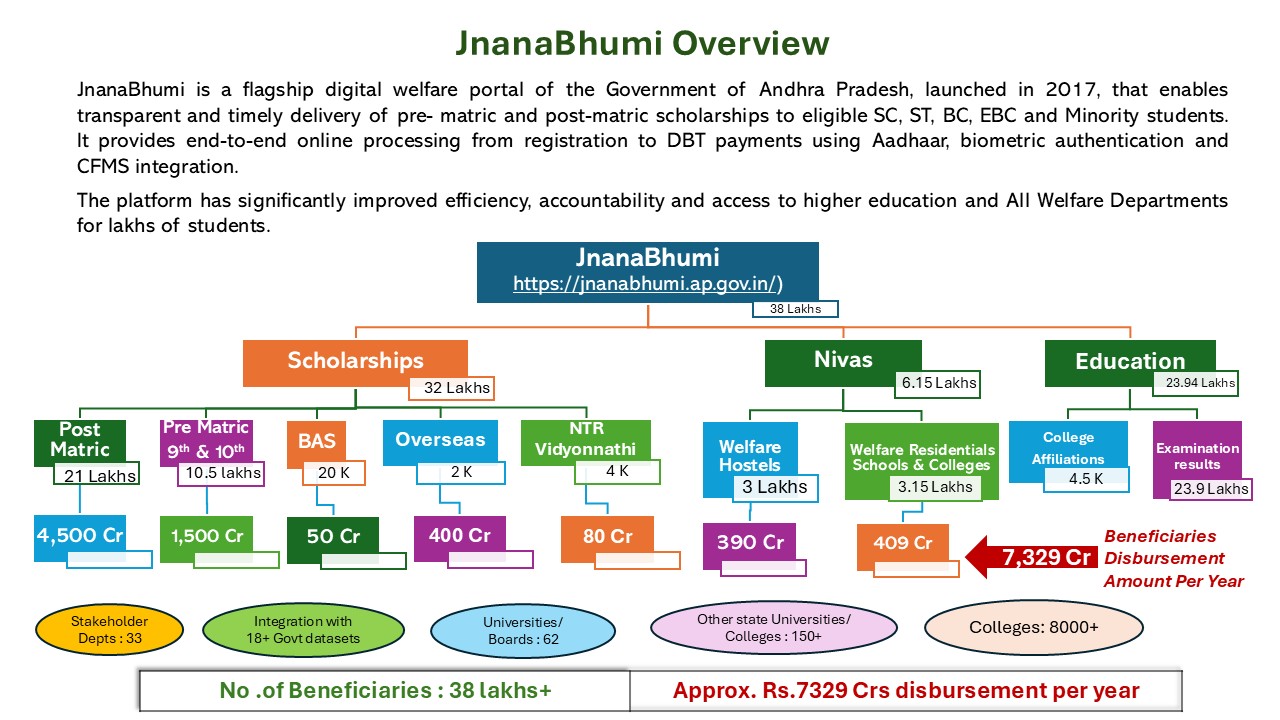
- Built an integrated digital platform (JnanaBhumi + JNB-NIVAS) to digitize end-to-end workflows for scholarships and hostel monitoring.
- Integrated multiple government datasets/systems (e.g., UIDAI/Aadhaar, CFMS, SSC, Civil Supplies, NSP, etc.) to enable end-to-end automation and verification.
- Implemented real-time validation & automation for eligibility/identity/institution checks to reduce manual scrutiny and errors.
- Enabled Direct Benefit Transfer (DBT) with CFMS/payment-gateway integration for secure, timely scholarship/vendor payments.
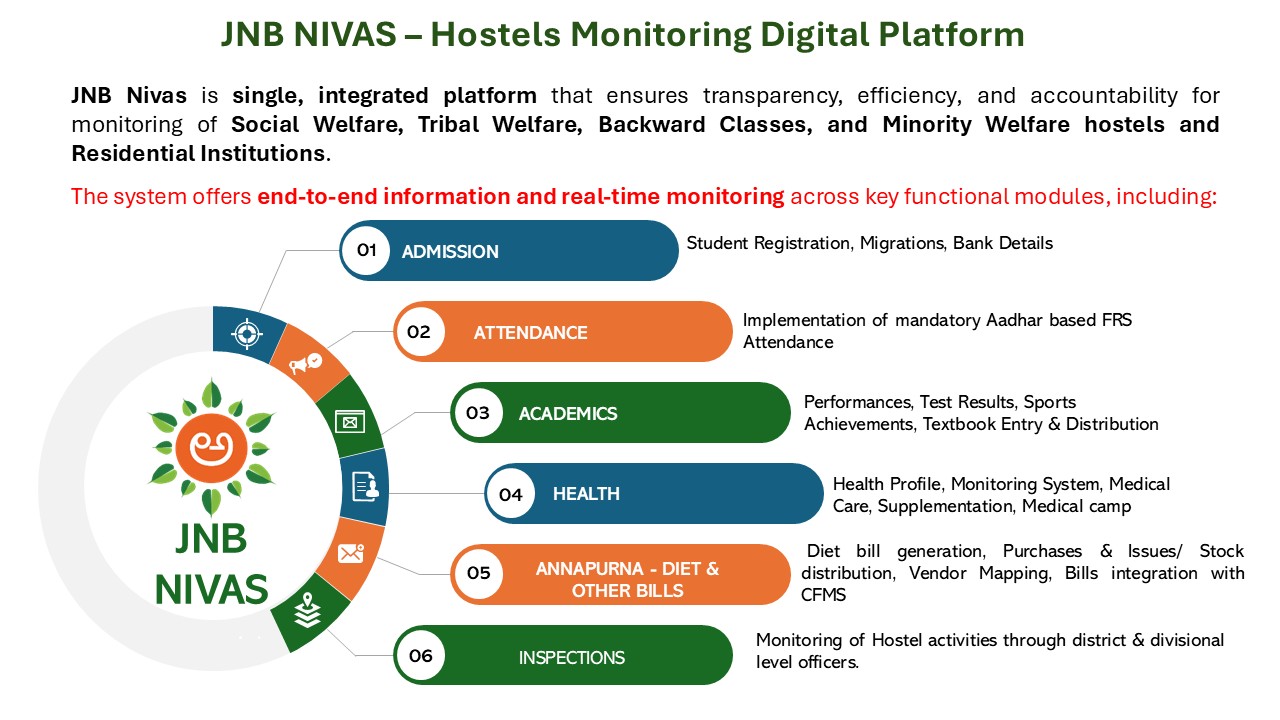
- Rolled out NIVAS functional modules (Admissions, Attendance, Academics, Health, Annapurna Diet, Inspections, Vendor/stock/bill integration) for real-time hostel governance.
Outcomes
- Processing time reduced from weeks/months to days via end-to-end digitization and paperless workflows.
- Secure cashless settlements (CFMS/UPI) improved transparency and trust; presentation highlights 100% digital payments.
- Inclusive access expanded for marginalized students with automated workflows, real-time tracking, and improved institutional accountability.
- Unified governance improved transparency, efficiency, and cost optimization through attendance-linked services and integrated academic/nutrition/health management.
- Data-driven decisions strengthened via dashboards/analytics; positioned NIVAS as a scalable, secure, replicable digital governance model.
Challenges
- Complex multi-stakeholder integration (welfare departments, institutions, banking/financial systems) into one platform.
- Digital literacy barriers for students/field users, requiring training, support, and assisted adoption.
- Infrastructure & scalability constraints (server capacity, peak-load performance, uptime) for real-time validation and statewide usage.
- Data quality & duplication risks, needing strong Aadhaar/e-KYC, biometric attendance, and cross-database checks.
- Connectivity gaps in remote/tribal areas, affecting real-time transactions and timely updates.
Innovation
- WhatsApp-based citizen access (Mana Mithra / RTGS integration) for quick student status checks—reducing friction at the last mile.
- Biometric/Aadhaar-backed authenticity controls (e-KYC, biometric attendance, e-acknowledgements) to prevent duplicates and improve accountability.
- Attendance-linked scholarships and services (scholarships/diet governance tied to verified attendance) to improve fairness and reduce misuse.
- Real-time dashboards + audit trails + MIS analytics enabling continuous monitoring from institution to district/state levels for data-driven governance.
- AI-based anomaly detection, DigiLocker integration, mobile-first architecture, occupancy & fund analytics, auto-grievance workflows, and AI CCTV in hostels.
SKOCH Award Nominee
Category: Social Welfare
Sub-Category: Social welfare – Social welfare and Social Protection Programs
Project:Jnanabhumi
Start Date: 01-04-2024
Organisation: Directorate of Social Welfare Andhra Pradesh
Respondent: Ms. Boddu LavanyaVeni, Director
https://jnanabhumi.ap.gov.in/
Level: Excellence
Video
See Presentation
Gallery
Case Study
JnanaBhumi & JNB-NIVAS: Transforming Student Welfare Delivery and Hostel Governance through End-to-End Digital Governance in Andhra Pradesh
JnanaBhumi and JNB-NIVAS were conceived by the Government of Andhra Pradesh as a digital governance reform to fix long-standing inefficiencies in student welfare delivery and to ensure inclusive access to education for marginalized groups (SC, ST, BC, EWS, minorities, and differently abled). The intervention became operational from 30-06-2017 and has evolved through phased expansion—starting with portal launch, then deeper verification and financial integration, followed by improved accessibility, accountability, and analytics, including cloud migration for scalability.
Before the reform, Andhra Pradesh’s education welfare ecosystem operated at a scale where manual processes became unsustainable. Scholarship and welfare management covered 6,875+ colleges and 20+ lakh students, yet workflows were slow and error-prone due to repetitive data entry and weak automation. Fragmented information and dependence on physical documents caused delays, higher administrative costs, difficult verification, and poor coordination among stakeholders. Students and institutions had limited visibility into application status and fund disbursement, weakening trust and equity outcomes. In hostels, manual diet planning and paper-based health records contributed to inaccuracies, wastage, and delayed care, while the absence of standardized teacher–student mapping created confusion in attendance monitoring and accountability.
The solution was designed as a unified, end-to-end digital architecture: JnanaBhumi for scholarship lifecycle management and JNB-NIVAS for hostel monitoring and welfare service delivery. JnanaBhumi digitized the journey from registration and applications through verification, scrutiny, sanctions, and Direct Benefit Transfer, with multi-source validation to ensure accuracy and prevent duplication. Automated, real-time verification was enabled through integrations that check income/caste/land, urban property, vehicle ownership, electricity usage, government employment status, IT returns, and academic/attendance dependencies, ensuring rule-based eligibility before sanction. The platform also integrated RTGS-linked WhatsApp governance (“Mana Mithra”) to let students check status conveniently, improving last-mile transparency. In parallel, JNB-NIVAS established a single monitoring system for welfare hostels and residential institutions, covering admissions, attendance, academics, health, diet and bill management (Annapurna), and inspections, supported by Aadhaar-based biometric (FRS) attendance and vendor/stock/bill integration with CFMS for traceability.
Implementation focused on standardizing processes, embedding auditability, and integrating finance and identity systems to build trust at scale. The program expanded from early digitization and dashboards to deep financial integration, reducing disbursement timelines (including references to T+3 days in early integration) and moving toward faster cashless settlements. Key outcomes reported include a reduction in scholarship processing time from weeks to days, cashless settlements via CFMS and UPI, stronger accountability through attendance-linked services, and real-time analytics for policy insight and institutional oversight. The presentation also emphasizes 100% digital payments, a “single source of truth” enabled by Aadhaar and biometric authentication, removal of duplicate beneficiaries, and automated hostel attendance and mess bill generation—collectively strengthening governance through dashboards, MIS, and digital audit trails while empowering students through mobile access, alerts, and grievance redressal.
The program also surfaced practical challenges typical of whole-of-government transformation. Integrating multiple stakeholders—welfare departments, educational institutions, and banking systems—into a single platform required careful coordination and process re-engineering. Change management was essential because some institutions initially resisted shifting away from long-standing manual practices, affecting early adoption and data consistency. Ongoing dependencies on device availability (PCs, mobiles, biometric scanners), low digital literacy among some beneficiaries, and infrastructure gaps in remote and tribal areas (power/connectivity) occasionally constrained seamless real-time operations, requiring continued training, helpdesk support, and iterative improvements based on user feedback. Looking ahead, the roadmap includes AI-based anomaly detection, DigiLocker integration, a mobile-first architecture, real-time occupancy and fund utilization dashboards, automated grievance workflows with escalation, and AI-based CCTV surveillance in hostels—positioning JnanaBhumi and NIVAS as scalable, replicable benchmarks for welfare-led education governance.
For more information, please contact:
Ms. Boddu LavanyaVeni at swcommissioner@gmail.com
(The content on the page is provided by the Exhibitor)