
TNSPARK – State Council of Education Research and Training, Tamil Nadu

TNSPARK
Problem
- Curriculum Gap: Foundational skills of the emerging economy—such as AI, Coding, and Robotics—were present in elite private school curricula but completely absent from government school syllabi.
- Workforce Disadvantage: A student entering the workforce without the capability to work alongside, direct, and critically evaluate AI systems faces a career ceiling that effort in other domains cannot lift.
- Geographical Inequality: Rural government school students with identical intellectual capacity to urban students lacked access to these critical tech skills during their formative years.
- Lack of Early Layered Exposure: Without early exposure to AI, coding, and robotics during Classes 6–9, students are unable to build the layered, progressive understanding these fields require.
- Foreclosed Career Trajectories: Missing early foundational exposure to these fields stops students from identifying with or imagining future careers in technology, engineering, AI ethics, and robotics design.
Solution
- Age-Appropriate Curriculum: SCERT developed a comprehensive, activity-based, and project-oriented curriculum integrating AI, coding, robotics, and digital tools tailored for Classes 6–9.
- Large-Scale Teacher Training: Phased training programs equipped teachers with the necessary technical knowledge and pedagogy, backed by continuous mentoring and teaching-learning resource materials.
- Infrastructure Establishment: Hi-Tech Computer Labs were built and fitted with the required hardware, software, and bilingual digital resources to ensure equitable classroom access.
- Blended Instructional Model: A delivery system combining classroom teaching with digital platforms was implemented to prioritize hands-on, experiential learning and real-world projects.
- EMIS-Based Monitoring and Evaluation: The implementation process was continuously monitored using the Education Management Information System (EMIS), backed by periodic student assessments to drive feedback-based improvements.
Outcomes
- Mass Skill Equipping: The initiative successfully equipped approximately 6 lakh government school students with vital future-economy skills in AI, coding, and robotics.
- Systemic Resource Creation: Over 5,000 schools were transformed into AI-enabled learning hubs, and more than 6,000 teachers were upskilled into permanent technology education assets within the public school system.
- Shift in Assessment Paradigm: A massive statewide assessment of over 3.35 lakh students evaluated actual competencies (Creative Thinking, Critical Thinking, and Problem Solving) instead of relying on traditional rote-based exams.
- High Student Competency Levels: The assessments revealed that 61% of students scored above 80 (demonstrating high future-readiness) and 30% scored in the 50–79 range, leaving only 9% requiring targeted remediation.
- Dismantled Socioeconomic Myths: The results proved that systemic investment allows rural and first-generation learners in government schools to excel in advanced technical skills just like private school peers.
Outcomes
- Remote Infrastructure Gaps: Connectivity issues, hardware maintenance constraints, and infrastructure deficits in certain remote regions challenged seamless technology integration.
- Initial Adaptation Resistance: Early implementation was slowed by adaptation difficulties among both teachers and students when managing unfamiliar digital tools and newer pedagogies.
- Timetable and Instructional Time Constraints: Limited dedicated hours within the existing school timetable restricted the depth of engagement and completion of hands-on, project-based activities.
- Regional Scaling Disparities: Resource optimization issues in remote areas created regional disparities that required sustained monitoring and phased deployment strategies to rectify.
- Variable Teacher Competency Levels: Ensuring consistent quality of program delivery across all classrooms was hindered by the varying baseline technical competencies among the vast teaching staff.
Outcomes
- Curriculum First, Hardware Second” Principle: Unlike typical tech rollouts that start with equipment, the program innovated by designing an activity-based pedagogical framework first, ensuring technology served specific learning outcomes.
- Bilingual Tech Content: Textbooks and digital tools were uniquely engineered to support bilingual (Tamil and English) content, preventing language barriers from hindering advanced tech literacy.
- EMIS-Anchored Tracking at Population Scale: Leveraging an established statewide Education Management Information System (EMIS) allowed real-time tracking, standardisation, and data-driven monitoring of a major tech curriculum across thousands of schools.
- The SPARKCHAMP Ecosystem: Introducing a competitive platform allowed government school students from underserved communities to apply skills dynamically and win contests alongside heavily resourced private institutions.
- Documented, Transferable Blueprints: TNSPARK developed fully documented SCERT curricula, monitoring frameworks, and teacher training protocols engineered to act as a turnkey national blueprint for other Indian states.
SKOCH Award Nominee
Category: State Government – Other States Government
Sub-Category: secState Government – Other States Government
Project: TNSPARK
Start Date: 7-24-2025
Organisation: State Council of Education Research and Training, Tamil Nadu
Respondent: B. Chandra Mohan
https://tnschools.gov.in/
Level: Premium Star
Video
See Presentation
Gallery


Case Study
TNSPARK – State Council of Education Research and Training, Tamil Nadu
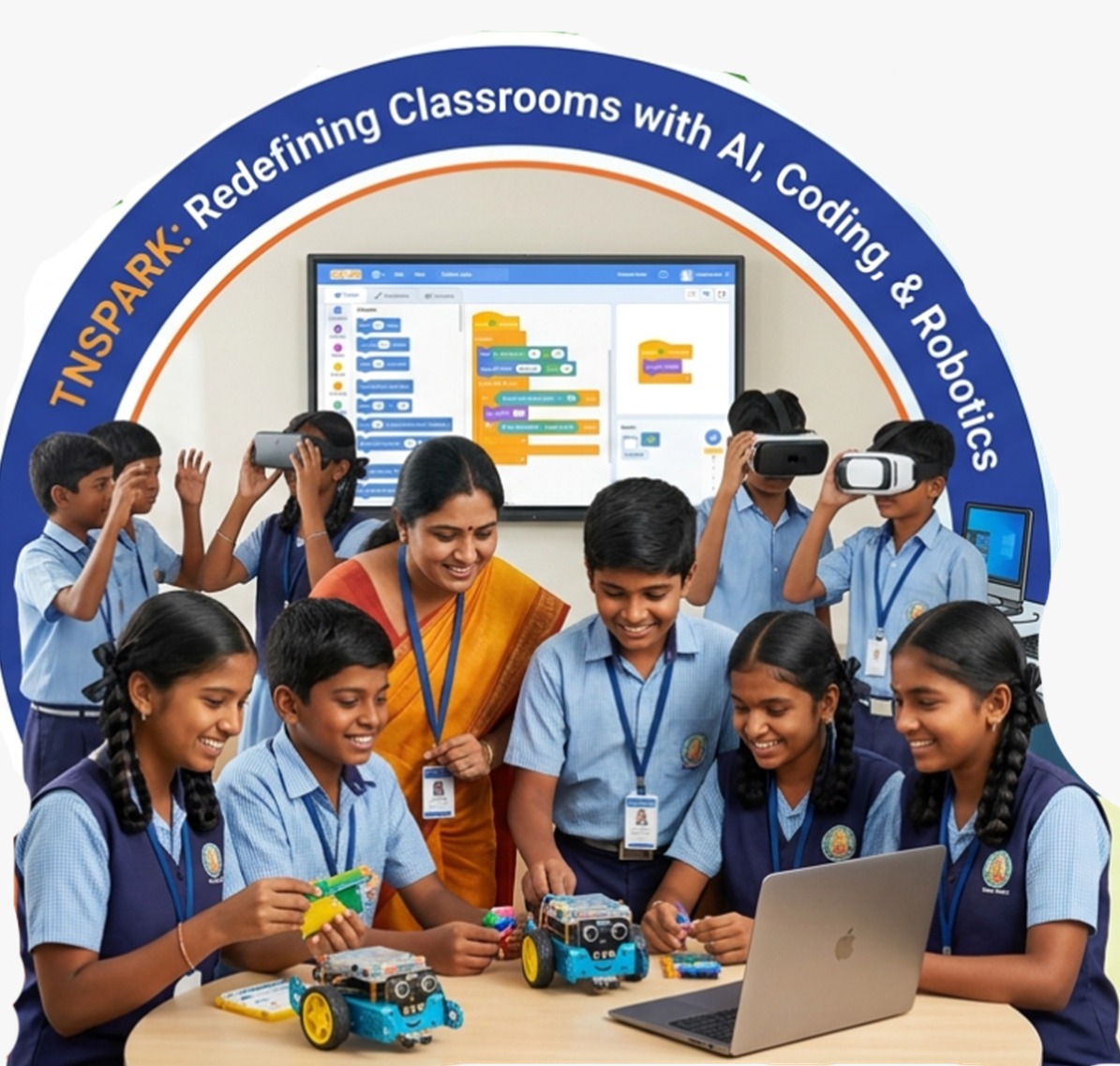
The Government of Tamil Nadu, through the State Council of Educational Research and Training (SCERT), launched the Tamil Nadu Schools Programme for AI, Robotics & Knowledge of Online Tools (TNSPARK) on July 24, 2025, to bridge a critical socioeconomic divide. Historically, advanced tech skills like AI, coding, and robotics were confined to elite private school curricula, structurally excluding rural and first-generation government school students from the emerging global economy. To resolve this, SCERT enacted an aggressive, phased deployment strategy that moved away from hardware-first models, prioritising an activity-based bilingual curriculum alongside intensive teacher training. Over 6,000 public school educators were trained as permanent technology multipliers, and 5,000 schools were upgraded with Hi-Tech Computer Labs, shifting the public education paradigm toward equitable technological literacy.
Despite major operational bottlenecks—including persistent connectivity and infrastructure gaps in remote regions, initial pedagogical adaptation resistance among staff, and rigid school schedules—the project achieved unprecedented population-scale success. TNSPARK successfully integrated future-ready skills for approximately 6 lakh students in Classes 6–9. A massive statewide assessment of 335,634 students conducted on December 18, 2025, validated the strategy, revealing that 61% of tested students scored above 80% in critical thinking, problem-solving, and AI applications. This marked a monumental cultural shift from traditional rote-based learning to real capability measurement. The initiative also fostered the SPARKCHAMP competitive ecosystem, enabling underprivileged students to successfully compete against well-resourced private institutions. By establishing fully documented, transferable operational frameworks integrated with the state’s EMIS tracking system, TNSPARK has built a scalable and highly replicable blueprint for national digital inclusion in public education.
For more information, please contact:
B. Chandra Mohan at schsec@tn.gov.in
(The content on the page is provided by the Exhibitor)