
SRA DigiSeva – Smart, Secure & Transparent Services (Blockchain + Artificial Intelligence) – Slum Rehabilitation Authority, Brihanmumbai

SRA DigiSeva – Smart, Secure & Transparent Services (Blockchain + Artificial Intelligence)
Problem
- Slum dwellers had limited access to SRA information and grievance services because they depended on physical visits, office hours, and faced language and inclusion barriers.
- Handwritten grievance letters were processed manually, causing delays, inconsistent classification, misrouting, and a heavy departmental workload.
- Irrelevant, abusive, and non-SRA grievances entered the system, reducing administrative efficiency and diverting attention from genuine cases.
- Fragmented, paper-based record-keeping created risks of document loss, tampering, weak auditability, and poor trust in critical records.
- Rising demand for transparent, secure, scalable, and citizen-centric governance created the need for AI automation and blockchain-backed integrity.
Solution
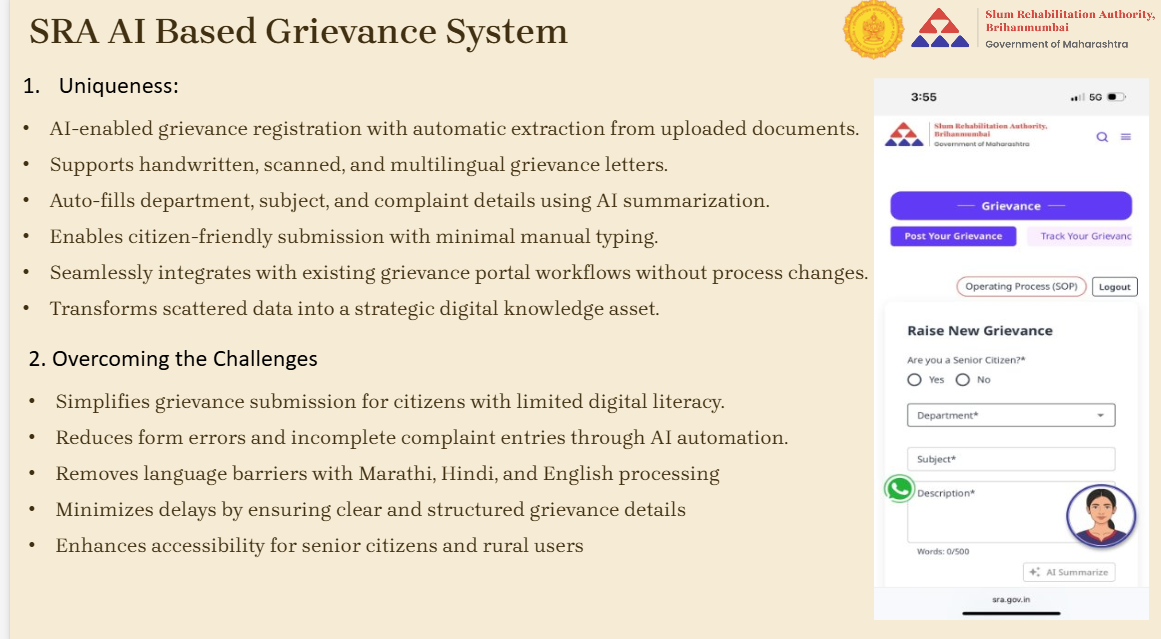
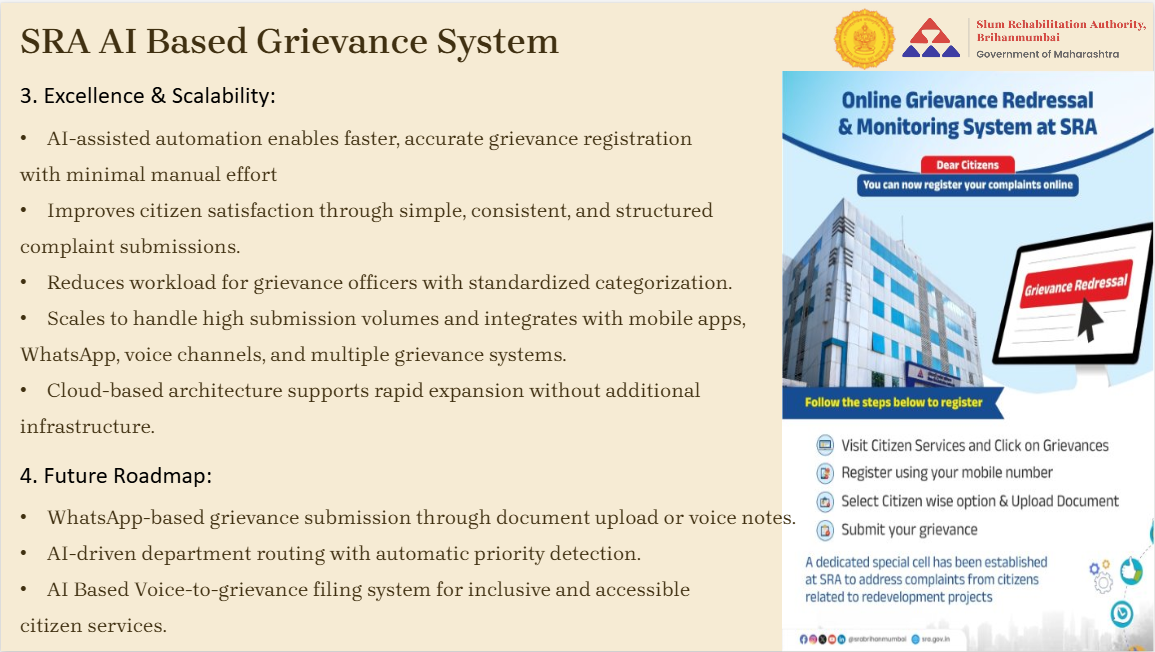
- Deployed an AI-based Grievance Management System using OCR and NLP to digitise, summarise, classify, and route grievances automatically.
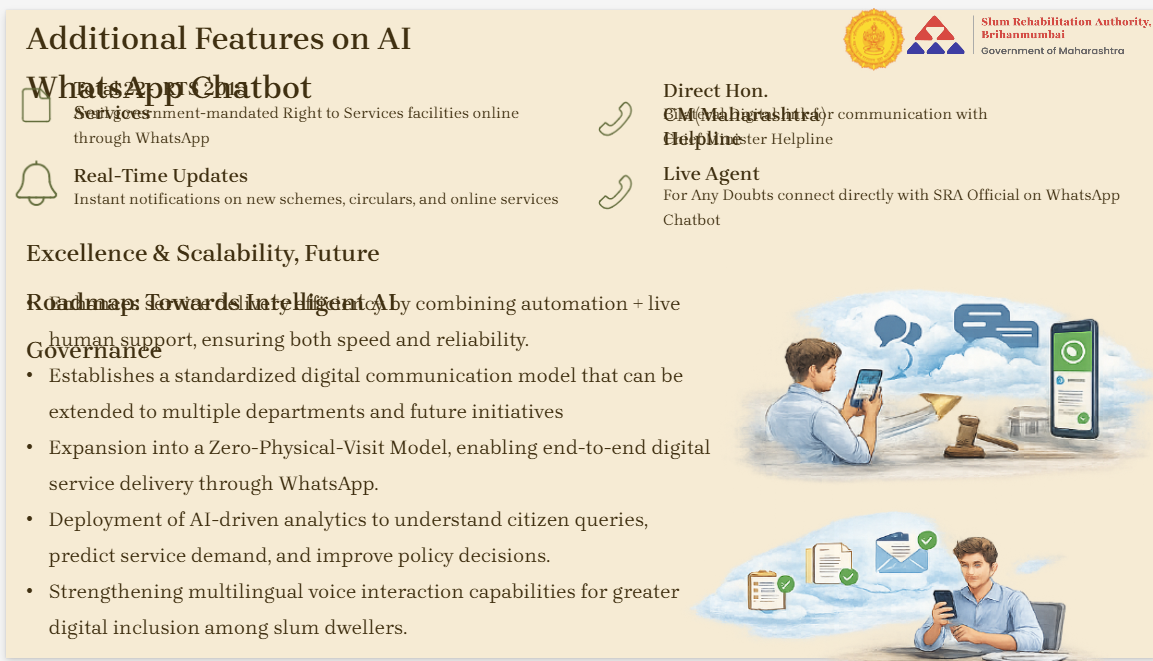
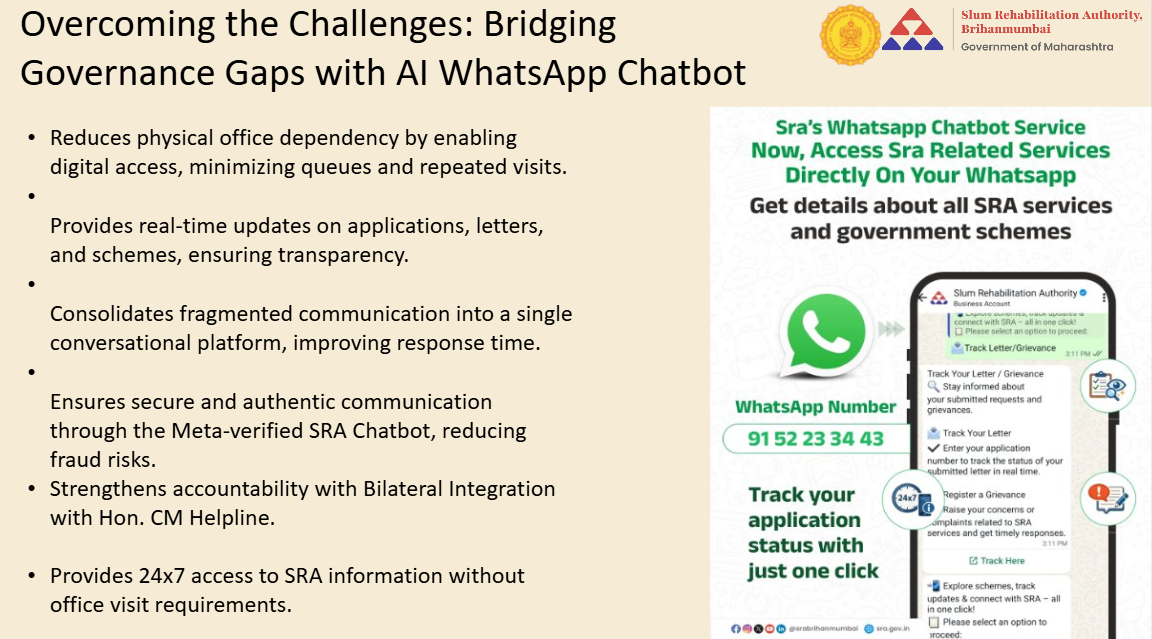
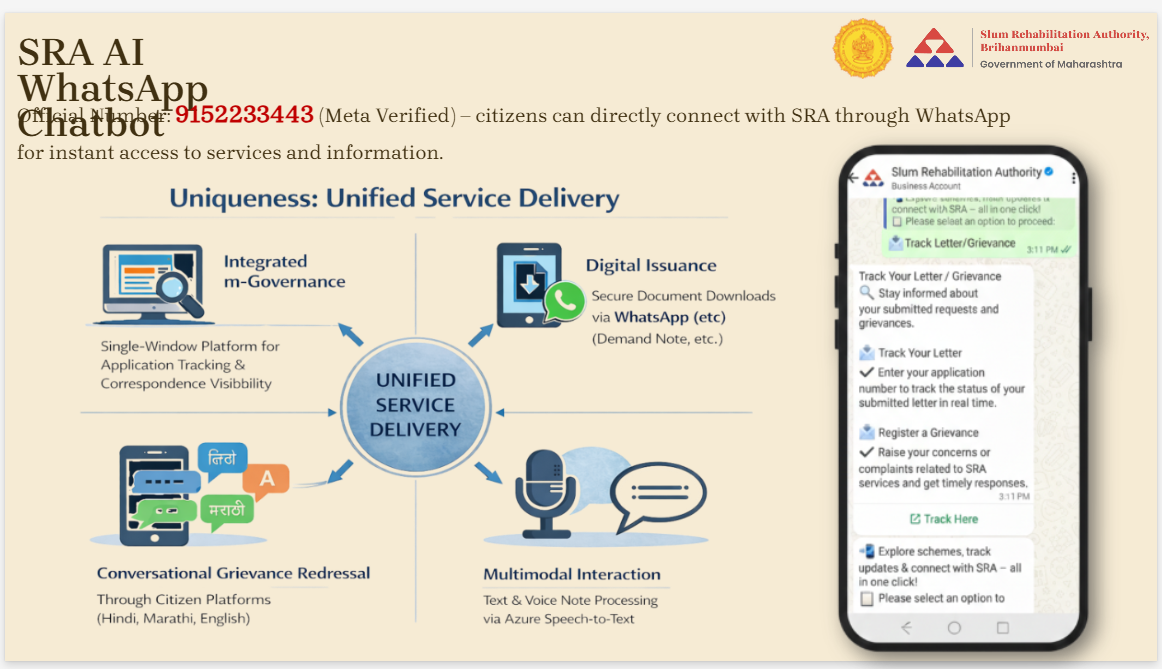
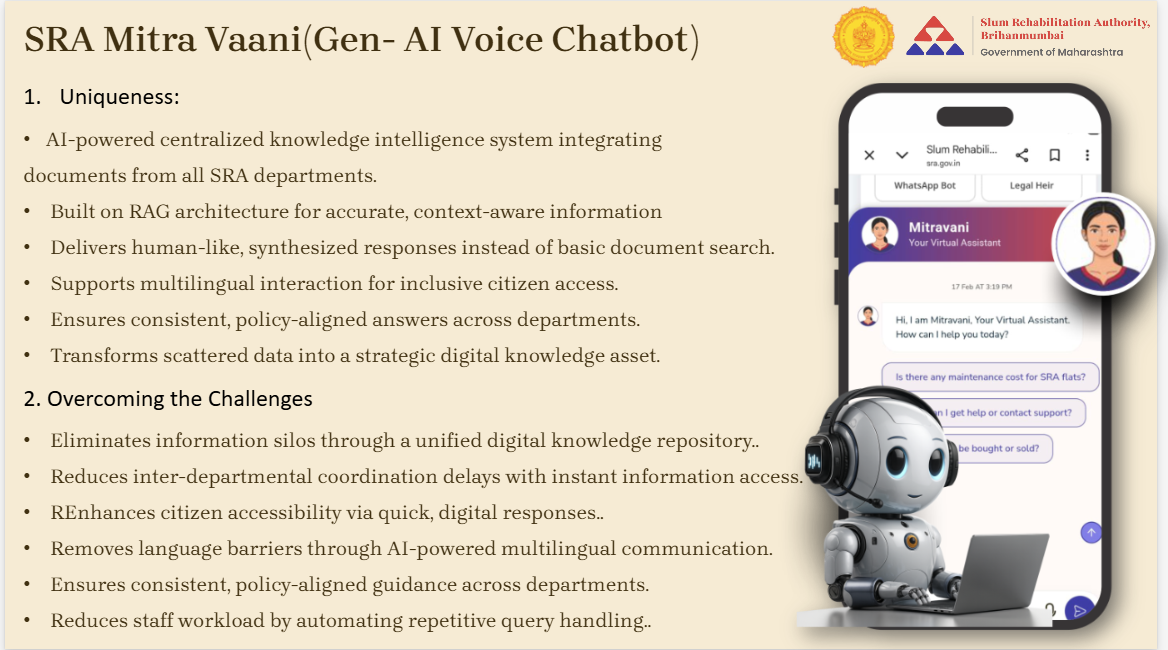
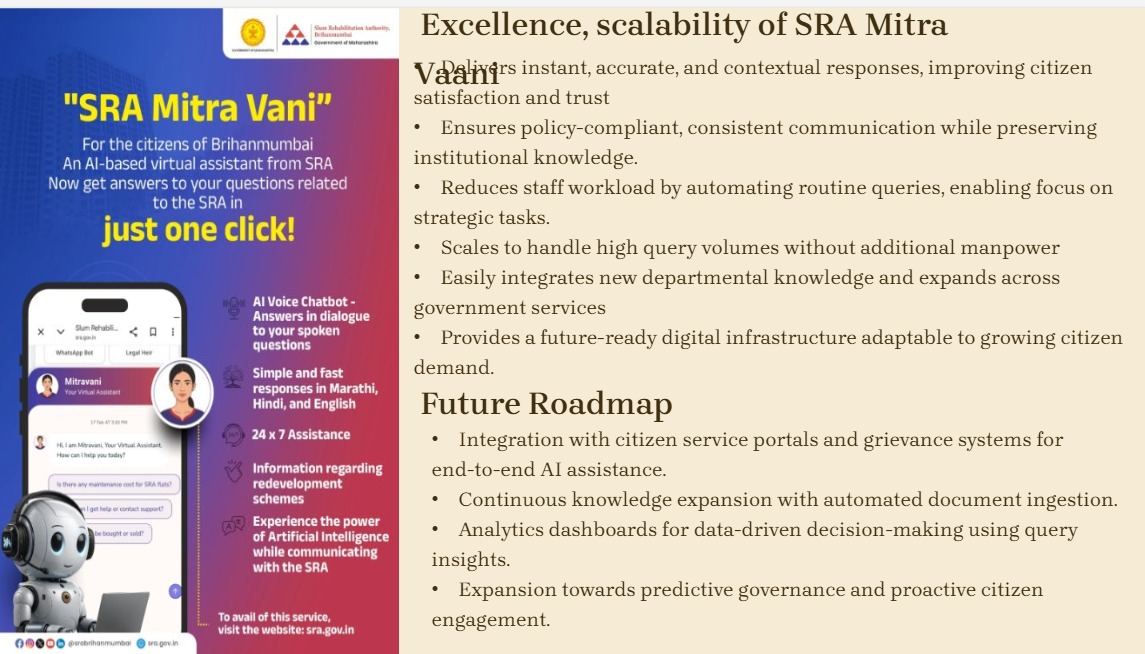
- Implemented MitraVaani and the AI WhatsApp Chatbot to provide 24×7 multilingual access to SRA information and citizen services.
- Embedded AI guardrails to detect inappropriate language, filter non-SRA complaints, and identify non-genuine submissions.
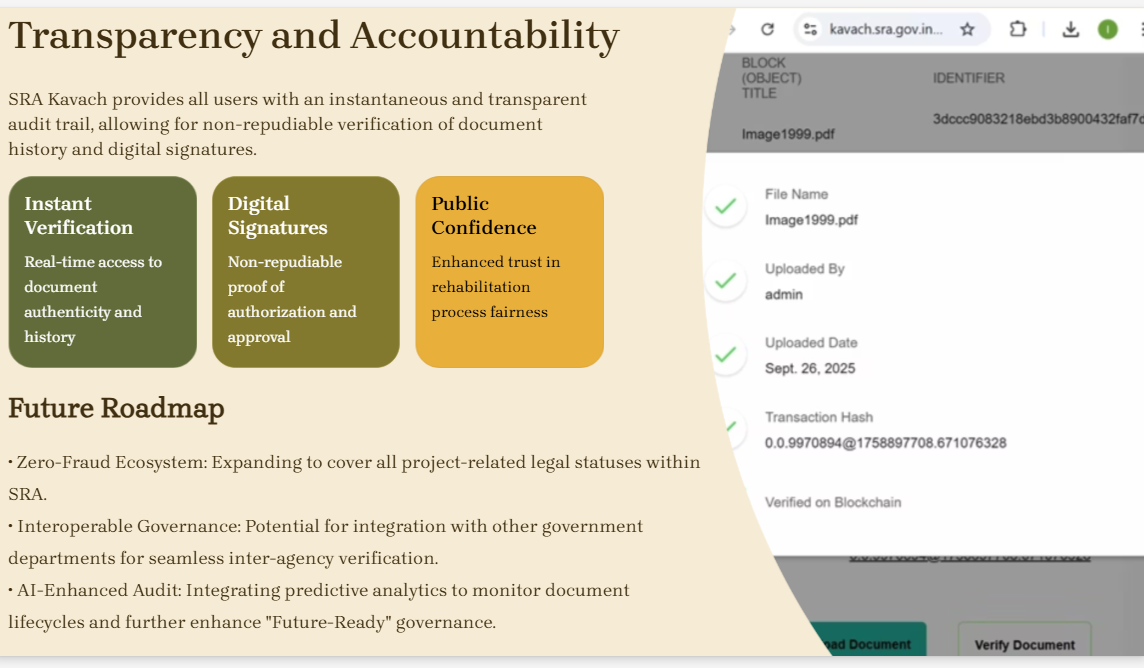
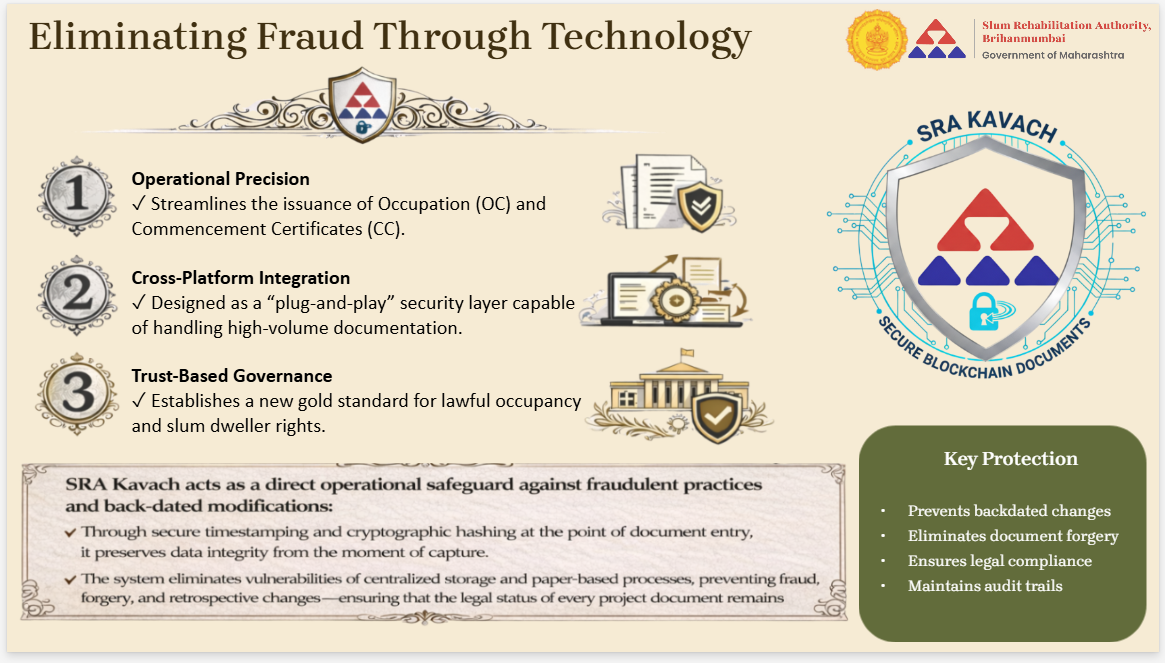
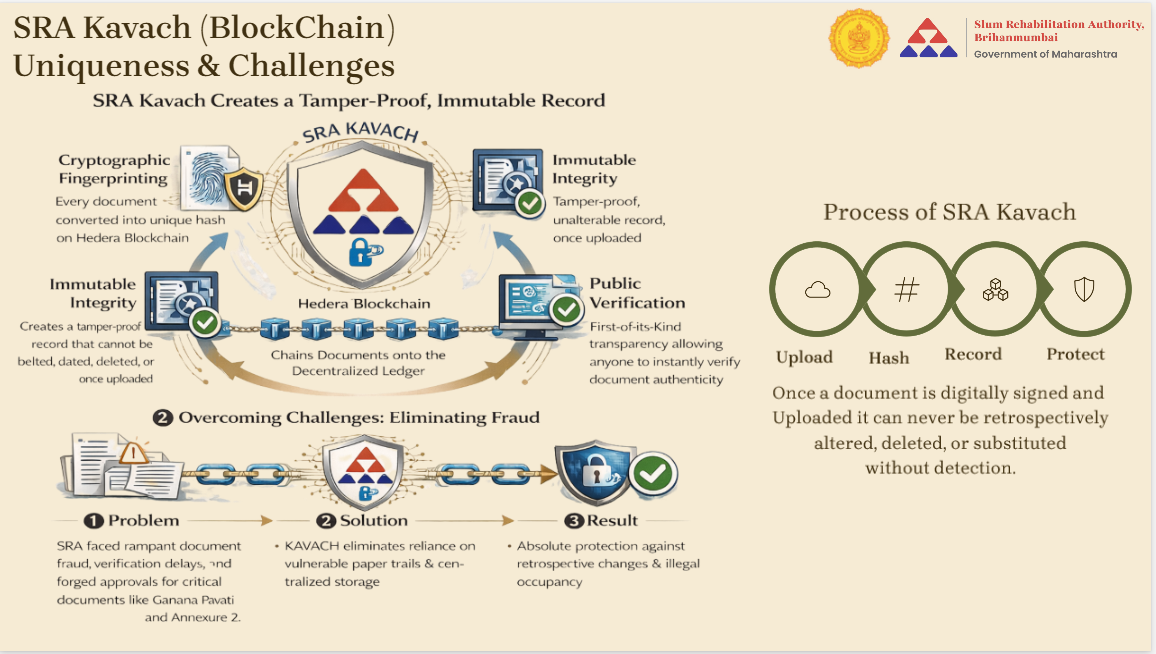
- Introduced SRA Kavach, a Hedera-based blockchain layer, to secure grievance records and key documents like Annexure II, survey slips, CC, and OC.
- Integrated the ecosystem on secure cloud infrastructure with departmental workflows for auditable, scalable, and transparent service delivery.
Outcomes
- Grievance processing became faster through AI digitisation, automated classification, and direct routing to the right departments.
- Citizen access improved through 24×7 multilingual digital interfaces, reducing dependence on office visits and repeated follow-ups.
- Departmental workload was reduced because irrelevant and abusive grievances were filtered before consuming officer time.
- Data integrity and auditability improved through tamper-proof blockchain storage and transparent verification trails.
- Transparency, consistency, and citizen trust increased through secure records, faster responses, and standardised AI-enabled governance.
Challenges
- Handling diverse handwritten complaint formats and multiple languages required accurate OCR and NLP tuning for reliable automation.
- Integrating AI systems with existing departmental processes had to be done without disrupting ongoing grievance handling.
- Building trust and adoption among citizens with limited digital literacy remained a significant implementation challenge.
- Ensuring privacy, security, and auditability for sensitive records during cloud and blockchain deployment requires strong safeguards.
- Designing AI guardrails that blocked irrelevant complaints without excluding genuine grievances required careful governance calibration.
Innovations
- Use of blockchain-based SRA Kavach to create immutable, tamper-evident protection for critical rehabilitation and occupancy documents.
- AI-enabled grievance intake that can process handwritten, scanned, and multilingual letters with automatic extraction and summarisation.
- Multilingual AI citizen support through WhatsApp, website, and voice interfaces, making public services conversational and always available.
- RAG-based MitraVaani knowledge system that delivers context-aware, policy-aligned responses instead of simple document search.
- A combination of AI automation, live-agent support, blockchain security, and future-ready analytics creates a replicable digital governance model for other departments.
SKOCH Award Nominee
Category: Autonomous Body
Sub-Category: Autonomous Body
Project: SRA DigiSeva – Smart, Secure & Transparent Services (Blockchain + Artificial Intelligence)
Start Date: 6-02-2025
Organisation: Slum Rehabilitation Authority, Brihanmumbai
Respondent: Mahendra Kalyankar
https://www.sra.gov.in/
Level: Excellence
Video
See Presentation
Gallery
Case Study
SRA DigiSeva: Smart, Secure and Transparent Digital Governance for Urban Rehabilitation
SRA DigiSeva is a significant public-sector digital transformation initiative developed by the Slum Rehabilitation Authority, Brihanmumbai, to improve accessibility, transparency, efficiency, and trust in citizen-facing services. The project, operational from 02 June 2025, was designed to address persistent governance challenges affecting slum dwellers and other stakeholders who depend on SRA for rehabilitation-related information, grievance redressal, and legally important documentation. Rather than pursuing isolated digitisation, SRA adopted an integrated model that combines artificial intelligence, multilingual citizen interfaces, and blockchain-based security to modernise service delivery in a high-volume and socially sensitive environment.
The need for such an intervention arose from deep structural challenges in the conventional system. Slum dwellers often had to rely on physical office visits, restricted working hours, paper-based processes, and fragmented communication channels to access information or submit grievances. Handwritten complaints had to be manually read, classified, and forwarded, resulting in delays, misrouting, inconsistent handling, and heavy administrative burden. Language barriers further reduced inclusion, while the absence of intelligent filtering mechanisms allowed irrelevant, abusive, or non-SRA grievances to consume official time. At the same time, critical documents such as Annexure-II, Survey Slips, Occupancy Certificates, and Commencement Certificates were exposed to risks of tampering, loss, and weak auditability.
To solve these problems, SRA DigiSeva introduced a two-part AI-driven service layer supported by secure blockchain infrastructure. One key component is Mitravani, SRA’s multilingual AI-powered voice and chat assistant, available through the official website and WhatsApp. It provides citizens, architects, and developers with 24×7 access to verified information on services, rules, eligibility, and procedures in Marathi, Hindi, and English. By making reliable information available on demand, Mitravani reduces dependence on physical visits, cuts information asymmetry, and expands digital inclusion for vulnerable users. The project also treats citizen communication as a continuous service rather than an office-bound function.
The second major component is the AI-based Grievance Management System. This system allows citizens to submit handwritten, scanned, and multilingual grievance letters online. Using OCR and advanced natural language processing, it digitises the complaint, summarises the content, identifies the grievance type, and routes it automatically to the appropriate department. This substantially reduces manual effort and improves both speed and consistency. Built-in AI guardrails also flag inappropriate language, filter non-SRA grievances, and identify non-genuine submissions. This is especially important because the initiative was designed not only to digitise complaints but also to improve governance discipline by ensuring that official attention remains focused on genuine cases requiring action.
To strengthen trust and legal defensibility, SRA paired these AI systems with a blockchain-based security architecture using Hedera technology. This layer protects grievance records and critical documents through tamper-proof, traceable, and auditable cloud storage. Once a document is digitally signed and uploaded, it cannot be altered, deleted, or substituted without detection. The model is intended to prevent backdated changes, eliminate forgery, ensure legal compliance, and maintain transparent audit trails. This is particularly relevant in rehabilitation governance, where documentary integrity can directly affect housing rights and eligibility outcomes. By embedding immutability and auditability into the system, SRA moved from basic digitization toward a stronger trust architecture.
Implementation followed a phased approach. Senior leadership first identified the main gaps in accessibility, grievance handling, and data integrity, and then approved the adoption of AI-driven and secure digital systems. The next phase focused on solution design and development, followed by trust enablement through blockchain safeguards. Finally, the systems were deployed on secure cloud infrastructure, integrated across departments, and institutionalised through continuous monitoring. This phased strategy helped SRA manage challenges such as diverse handwriting styles, multilingual inputs, citizen digital literacy gaps, workflow integration, and the need to maintain privacy and auditability while introducing new technology.
The reported outcomes demonstrate clear administrative and citizen benefits. Grievance processing time was reduced through automated digitisation, classification, and direct routing. Citizen access improved through 24×7 multilingual interfaces, reducing physical office visits and enabling broader participation. Administrative workload declined because AI filtered irrelevant and abusive complaints before they entered the decision pipeline. Data integrity and auditability improved through secure blockchain storage, while transparency, consistency, and citizen trust increased through faster resolutions and traceable digital records. The initiative currently reports 300 internal beneficiaries and 500,000 external beneficiaries, indicating substantial scale and relevance.
SRA DigiSeva also has strong replication potential. Its modular AI architecture, cloud deployment model, and standardised workflows make it suitable for expansion across more offices, departments, and citizen channels. Future plans include deeper integration with internal systems, advanced analytics for grievance trends, real-time status updates, voice-based grievance filing, and broader multilingual service expansion. The larger lesson from the initiative is that effective digital governance must be citizen-centric, secure, and institutionally grounded. SRA DigiSeva shows that when AI is embedded within clear governance structures and supported by tamper-proof records, it can deliver not just efficiency, but also fairness, accountability, and public trust at scale.
For more information, please contact:
Mahendra Kalyankar at
(The content on the page is provided by the Exhibitor)